
Make delays visible
Describe unmet need alongside the burden people experience while waiting for care.
Healthcare access intelligence
A multidimensional framework designed to identify and visualize barriers to mental healthcare access.
Why MHABI exists
Waiting is only part of the picture. MHABI brings clinical burden, daily functioning, acute care use, and safety risk into a shared framework for understanding mental-health access.
Describe unmet need alongside the burden people experience while waiting for care.
Use a common framework to explore how access barriers differ across populations.
Structure evidence for validation studies and more informed service planning.
How MHABI works
Gather measures of delay, disease burden, acute care use, functioning, and safety risk.
Combine the five dimensions using the proposed MHABI scoring framework.
Explore patterns of access burden to inform research and service planning.
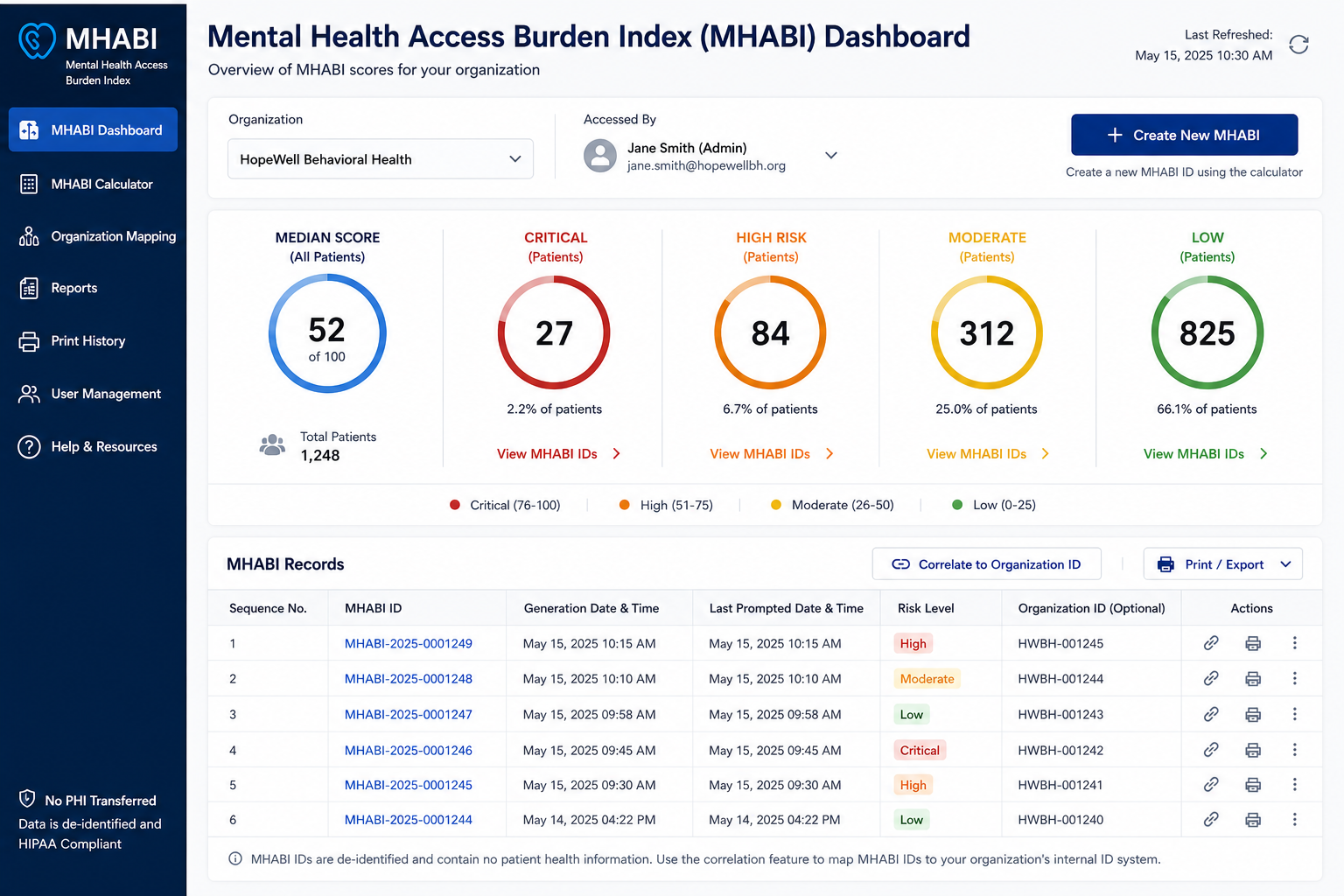
Dashboard preview
Preview how MHABI scores could help organizations monitor access burden, identify higher-risk cohorts, track waitlist pressure, and support data-informed resource planning using de-identified population-level insights.
Research credibility
MHABI is positioned to support publications, conference presentations, posters, validation activities, and future intellectual property documentation.